
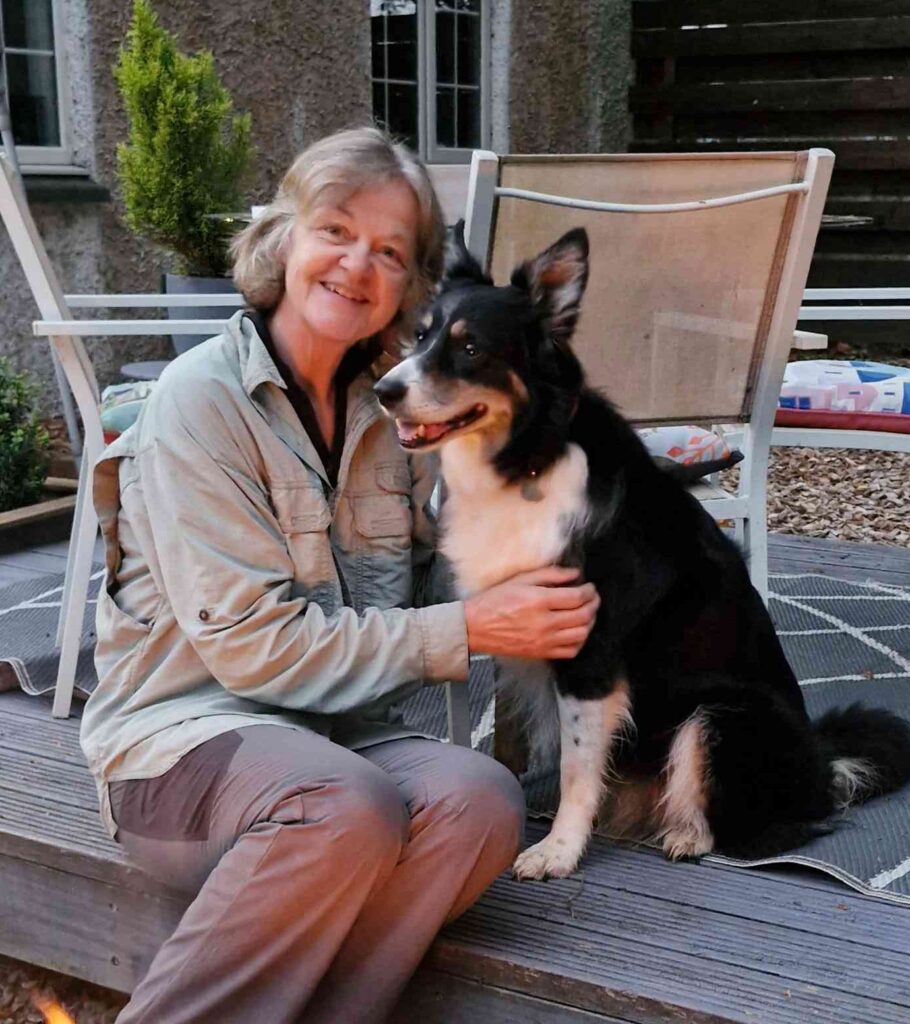
Do you remember the first few days with your dog, whether you brought a puppy home or an older rescue dog? What was it like, what did you feel at the time? Getting to know your dog and adjusting to their presence in your life can be a really hard journey. But aren’t the common difficulties of the early days and weeks often linked to us humans not really trusting our new furry family members? When and how does trust develop, on both sides?
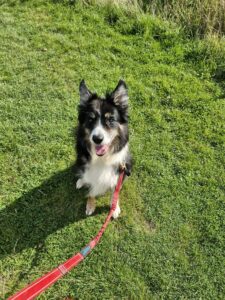
How I wish I could turn back the clock to last September, to that fateful day I decided to adopt Max. No, no, it’s not that I regret that decision – not at all, Max is the best thing that happened to me last year, by a long way. No, what I regret is that I didn’t have the nouse to buy a diary in which to record daily how those early days shaped up. Things change so quickly that it’s sometimes hard to keep it all before your inner eye. It’s easy to lose track of the little twists and turns, the steps and developments that characterise our journey, the angst and anguish of the first days and the frustrations of the first weeks, the rollercoaster of ups and downs, the shock of that ever-present four-legged needy creature, the upheavals and changes to life’s routines, the increasingly intense connection with your new family member.
Key feelings and events do, of course, stand out, although they seem almost unreal in hindsight. There’s the day when I first saw newbie Max in the Darlington Dogs Trust’s kennels, where I had been helping out as a volunteer once a week since July. Each kennel in the block I had been allocated to has two halves, one facing inwards, toward the main, wide corridor of the building stretching out from the reception, the other one facing the back with its doors opening onto the outside area from where staff access the kennels. I was walking down the corridor, glancing at dogs in the kennels. And there he stood. Motionless. Staring at me but seemingly not taking anything in. At least he didn’t show any reaction. Most dogs in kennels, when you look at them, respond somehow; they often start barking, pacing, rearing up, always in the hope of some action coming their way. Not so this one. He just stood there, in the middle of his kennel, seemingly shut down, his big black pointy ears with their grey lining pricked up but otherwise motionless. I thought he was a Border Collie, but I wasn’t entirely sure, because his tricolour coat was so shaggy and long and matted that I was wondering whether he was a crossbreed between a BC and a rough collie, which would have accounted for his long coat. When I next came by his kennel, he had rolled up into a tight ball, pressing his body against the bars, looking small. Again, no reaction. I felt sorry for him, as he was so clearly stunned by his new whereabouts.
A week later, the usual kennel tag with basic information had appeared by his kennel: Max, Border Collie, 10 years old. Nothing else. I asked if I could take him out for a walk. He pulled like a train, zig-zagging hectically from one invisible attraction – a scent, a sight, a sound – to the next. When I briefly stopped walking to pick up his poop, he whipped round and very swiftly gnawed through the little collar clip that acts as a safety device, providing another link between lead and collar. He was otherwise very sweet and gentle, happy to be cuddled, just not the most patient of creatures when asked to wait a second. I was soon to learn why.
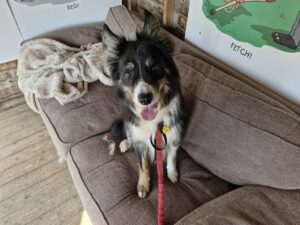
I asked about him in the office. I learnt he’d spent the last two years of his life in council kennels, because his owner had got into some kind of legal difficulties. What?! Two years in kennels, and that for a Border Collie, a breed renowned for its eagerness to work, its strong focus on humans, and its boundless energy, best expended herding livestock on large fields? Poor chap. And after all that time behind bars, Max had lost his house training. ‚He’s dirty in his kennels‘, I was told. I was intrigued regardless, but he was then taken off the volunteers‘ list of ‚green‘ dogs, apparently because he had snapped at the vet’s when being groomed. He was classed as an ‚amber‘ dog, i.e. a dog with some behavioural issues – out of bounds for new volunteers.
Some dogs have to wait many months before they get adopted, but I was worried Max wouldn’t stick around for long, despite his age, back story, and question marks around formal handling. I love collies, and my desire to not only look after kennel dogs and volunteer at local dog training schools but to have a dog of my own had grown over the summer. Because of Max’s amber tag, the only way I could spend more time with him was by expressing an interest in adopting him. I brought my partner along, and we walked Max and then played with him in one of the runs. We both fell for him, and shortly afterwards, the big day arrived and I took Max home. I had been worrying what he’d be like in the car, but there were no issues whatsoever, he simply jumped in and lay down.
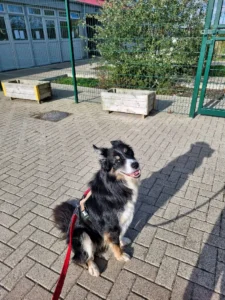
But it wasn’t all as easy-peasy as the ride home. Embarrassingly, the dominant emotion I feel when I think back to the early days of living with Max is one of shame. I didn’t really trust him, nor myself, for that matter. The problems revolved around home alone time and sleeping arrangements. I live in a terraced house with bare wooden stairs. My bedroom is upstairs. Here was the issue: in my heart of hearts, I wanted Max to sleep in my bed, I wanted to feel that warm, furry, breathing little creature next to me. But I worried that he’d slip on the stairs and do himself an injury. Max very much followed me around the house, and so had been clambering and blundering around on the stairs whenever I had to go to the bathroom. So I thought: ‚Well, he’ll have to sleep in his bed downstairs‘, and because he wasn’t reliably clean in the house, I thought I’d keep him downstairs and out of the carpeted lounge by putting not one, but two baby gates up: one at the bottom of the stairs, another one in the doorframe to the lounge. I feared he’d feel scared if I left him downstairs on his own and retired upstairs, so I brought my bedding downstairs and laid down on the sofa, expecting Max to be content with sleeping in his dog bed on the other side of the baby gate, as he’d be able to see and smell me just a couple of meters away from him. With a loud crash-bang!, the baby gate collapsed when Max, who proved to be rather agile and strong, tried to overcome the obstacle. It was late. I was tired. The baby gate idea was dead. I lay down on the sofa, Max jumped up and snuggled down into my arms. I still remember that tender joy at the dog settling down on and with me.
Why is it that I didn’t immediately draw the conclusion that we clearly must sleep close to one another? I hadn’t got much sleep during the first night, so for the second and third, I decided he’d have to stay in the kitchen (accident-proof) and I’d retire upstairs, having secured the baby gate across the kitchen doorway. I did hear scratching sounds but no barking, and I was so tired out that I fell asleep in my bed. The next morning came, and it turned out that Max had scratched (and quite badly damaged) the doorframes into the utility room and into the dining room. How frightened must he have been? A new house, and he was made to stay on his own in the kitchen. How could he NOT have been scared totally witless?!
Yet still I didn’t learn. Instead, I bought a crate, which I put up in the dining room, against the side of the stairs. It seemed to be the solution: I had barely put it together when Max happily went in to explore the cage, he ate in it, and even fell asleep in it.
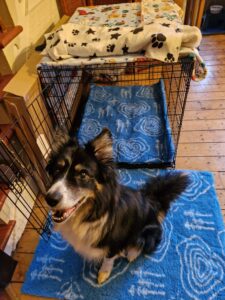
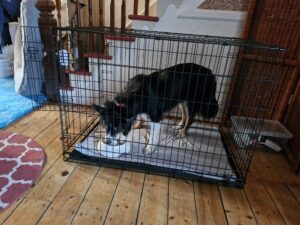
He was, however, much less happy when I locked the door behind him. He started rucking up his bedding and biting the crate bars. I brought my camping mat and bedding downstairs and slept next to him to keep him reasonably calm. Of course he got very wary of the crate and started refusing to go into it. I lured him into it by throwing a nice treat far into it. But he learnt quickly to elongate himself as much as possible; one foot remained outside of the crate, and he perfected an impressive yoga stretch to avoid being locked up.
I went to a local department store and asked how long it would take for them to deliver and fit a carpet to my hallway and stairs. At least 6 weeks, I was told, as it was the run-up to Christmas. A non-starter. Eventually I hit upon a much cheaper, quicker solution: I mail-ordered some stair mats with a silicon backing, which have been providing slip-proof grip for doggy paws ever since. Picture us, turning in for the night, ascending the stairs alongside each other, like an old couple.
And peace descended on my heart and household. Since that fateful day, the bedtime routine goes like this: some time after 11pm, I turn off the tele, put down my book, or shut down my laptop, turn off the lights in the living room, turn on the bright light in the hallway, gently raise sleepy Max from the sofa, telling him it’s time for his final wee of the day, time to go to bed. He lifts his head, props himself up, realizes I’m serious, and jumps off the sofa, following me along the hallway, through the dining room, kitchen, and utility room, finally stepping into the yard to have a tinkle, doing a u-turn, coming back into the house where I stop him to wipe off the worst traces of wee from the back of his front legs and from his left hind paw, with which he always manages to step into the yellow stream when moving off his chosen spot under the shrubs. We retrace our steps: out of the utility room, across the kitchen and dining room, at which point in time I carry out a swift lighting change: the bright hallway light is turned off, as is the low, indirect lighting next to the stairs, and then the upstairs hallway lights are turned on, which provides a guide for heading upstairs. I remind Max to go slowly, and we make our way up to the landing in front of the bathroom, turn the corner, and continue to the closed bedroom door. Max patiently waits for me to open the door, he steps into the room and jumps up onto my bed, laying down crossways. I close the curtains and turn on a little salt light, which gives off a warm, orange glow. I grab my nightie, tell Max I won’t be long, I perform my little bathroom routine, return to the bedroom, turn off the hallway light and try to find a space under the duvet, which is a mission characterised by fickle luck. At times, I need to gently push Max aside a little to be able to get into bed, and he then decides on the position to take: down by my feet, with his back turned to me, facing my side and resting his head on my hip, or – and this is my favourite – snuggling down into my arms, with his head lowered onto my shoulder, softly blowing onto my neck, with my arm gently wrapped around his back. I stroke his back, tell him I love him, wish him sweet dreams (yes, all quite sentimental, I know – but very satisfying). Moments later, we’re asleep.
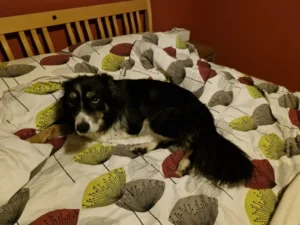
And ever since the sleeping arrangements were sorted, we could concentrate on getting to know and trust each other.